Perfume Concentration, Lead Times and Vegan Claims: What the Label Tells You
The concentration label on a perfume tells you less than most shoppers assume and more than most founders use. It is a house-dependent statement about how much perfume oil sits in the dilution, not a standardised measure of strength, and for a vegan brand concentration says nothing about veganism at all. The useful reading is practical: what each tier implies for performance, what it costs in development time, and where the vegan claim actually has to be proven.
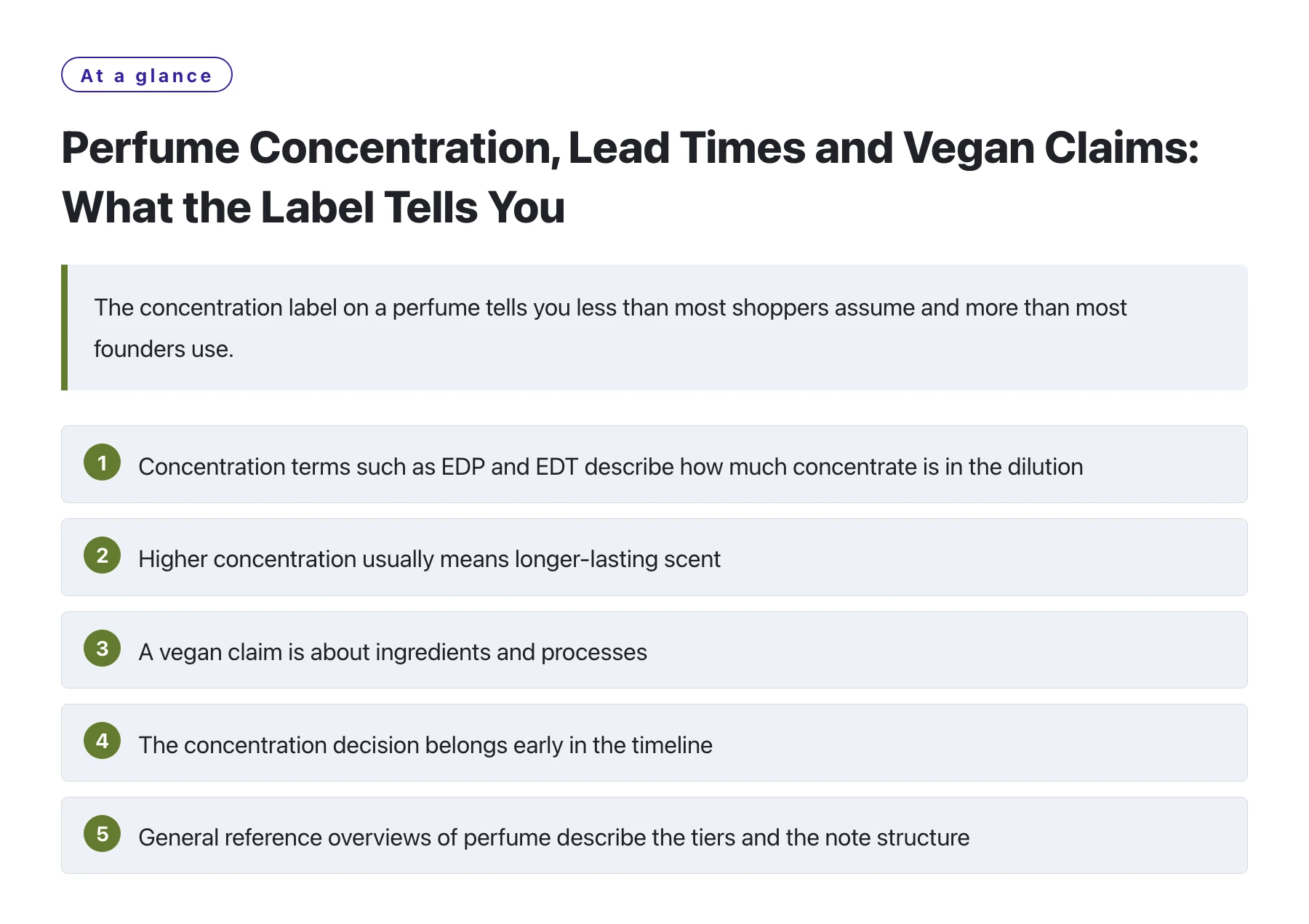
Key takeawaysConcentration terms such as EDP and EDT describe how much concentrate is in the dilution, and the ranges are not standardised across manufacturers. · Higher concentration usually means longer-lasting scent, but it also shifts the development work: more iterations, longer stability checks and different labelling decisions. · A vegan claim is about ingredients and processes, not about concentration, so it has to be substantiated from the formula rather than from the tier. · The concentration decision belongs early in the timeline, because it changes sampling rounds, stability runs and the finished label. · General reference overviews of perfume describe the tiers and the note structure, which is a useful baseline before your brand picks its own terms [1].
Every fragrance brief crosses the same fork quickly: what concentration should the product be? The answer drives the formula, the price structure and the label, yet most buyers answer from habit rather than from the timeline the choice commits them to.
This article separates the three things the label term touches: what the concentration actually means, how the choice changes the development calendar, and how a vegan positioning interacts with both.
What the concentration label does and does not mean
Left on its own description, the term on the label is a shorthand for how much perfume oil is diluted in alcohol and sometimes other carriers. Extrait or parfum sits at the high end, eau de parfum and eau de toilette below it, and eau de cologne lower still. There are no legally fixed percentages, so the same words can mean different strengths at different houses [1].
Before you choose a tier, it is worth reading what the concentration on a perfume label means in practice, because the practical consequences, how long the scent lasts, how it projects, how it performs in different climates, are what your customers will feel, not the percentage.
Tiers, implications and calendar effects
| Label term | What it usually implies | What it changes in development |
|---|---|---|
| Extrait / Parfum | Highest concentrate share, long wear | More material spend, longer stability view |
| Eau de Parfum | Stronger than EDT, house-dependent | Standard sampling rounds, careful labelling |
| Eau de Toilette | Lighter wear, popular for fresh profiles | Often fewer rounds; suits price-sensitive briefs |
| Eau de Cologne | Lightest common tier | Fast to sample; modest performance expectations |
Read the middle column as expectation and the third column as calendar. The longer the wear the label promises, the more verification the formula needs before it ships.
Where the concentration decision lands in the timeline
- Choose the tier in the briefState the target tier before sampling so every version is compared on the same base.
- Let the iterations runAt higher concentration, small changes in dosage shift performance; budget for extra rounds.
- Start stability at the final dosageThe stability run must use the exact dilution that will ship, not an earlier version.
- Build the label from the frozen formulaThe finished label, allergen data and claims all read from the frozen formula and dosage.
- Confirm the batch matchesThe batch in the bottle has to match the frozen formula, or the label describes a product that is not in the box.
Vegan positioning: what the claim rests on
Vegan is a claim about ingredients and processes, not about concentration. A perfume can be an extrait and still contain animal-derived materials; an eau de toilette can be vegan. What matters for the claim is the origin of every material in the formula and how the product is made.
Perfumers check the odour character and typical usage of each material in reference databases when building a formula [2], and for a vegan formula the same step carries an extra column: the origin of each material has to be traced. Claims like vegan are claims, and claims are meant to be substantiated from the product file [3].
The practical consequence for the timeline: decide the vegan positioning before sampling, so the material selection, the origin documentation and the claim wording are part of the brief rather than retrofits. That works best with a partner such as a manufacturer that builds custom scents that documents material choices as part of development.
The sample-versus-bulk gap is part of the timeline
One detail of the calendar repeatedly surprises new brands: the sample you approve is not identical to the bulk batch. Aging, dosage and handling all shift how a batch presents, and the difference is normal, but it has to be understood so it is not mistaken for an error.
Reading why a sample and the bulk order can differ before you approve your first sample gives you the vocabulary to tell a normal batch variation from a real defect, which keeps the timeline honest and the launch review calm.
Sources
- Wikipedia: Perfume —— An encyclopaedic overview of perfume covering definitions, history, the note structure of a fragrance and concentration terminology (background reference only).
- The Good Scents Company —— A reference database of aroma materials with odour descriptions, CAS numbers and typical usage information.
- European Commission: Cosmetic Products — Specific Topics —— EU pages covering specific cosmetics topics such as product claims, nanomaterials and animal-testing rules.
Frequently asked questions
Is eau de parfum always stronger than eau de toilette?
Usually yes within the same house, because EDP typically carries more concentrate. Across houses the terms are not standardised, so compare within one brand or verify the actual dosage from the supplier.
Does a higher concentration take longer to develop?
Generally, because performance expectations are higher and the formula has to be verified at the exact final dilution, which means more sampling rounds and a stability view that can run longer. Budget the calendar on the tier.
Can a perfume be both extrait and vegan?
Yes. Concentration describes the dilution; vegan describes the materials and processes. The two are independent, and the vegan claim has to be proven from the formula regardless of tier.
How is a vegan claim verified?
From the file: the origin of every material, the production processes and the claim wording used. Regulators expect claims to be substantiated, so a vegan claim stands or falls on the ingredient and process documentation.
Should I freeze concentration before or after sampling?
Before. The tier sets the dosage range, the performance target and the label, so sampling against the wrong tier means re-running the whole chain. Decide the tier in the brief, then let iteration work within it.